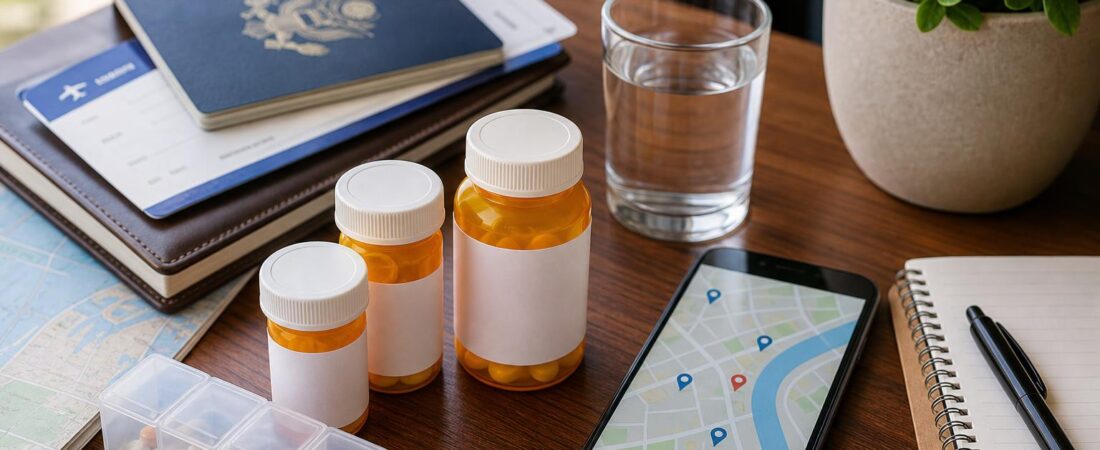
Quick answer: The safest way to refill prescriptions overseas is to avoid turning the refill into an emergency. Before you leave, ask your prescriber and insurer about an extended supply, keep medicine in original labeled containers, carry copies of prescriptions with generic names, and verify the rules for every country you enter or transit. If you do need medicine abroad, start with a licensed pharmacy or local clinician, compare active ingredients carefully, and do not assume a U.S. prescription, Medicare drug plan, or mail-order refill will work automatically outside the United States.
Prescription refills are not the romantic part of spending a month or a season overseas. They are not the beach, the market, the apartment balcony, or the cheap lunch everyone tells their friends about. But if you take daily medication, refills are part of the trip infrastructure. Ignore them long enough and a very ordinary problem can become the thing that eats your week.
For most Americans planning a one- to three-month stay abroad, the goal is not to master another country’s medical system. The goal is much more practical: leave with enough supply when you can, carry clear documentation, understand which medications deserve extra legal caution, and know what a calm fallback looks like if something changes. This article builds on the broader guide to prescriptions and routine care while living abroad part-time. Here, the focus is narrower: preventing refill pressure before departure and handling it sensibly if you still need help overseas.
Start before you leave, not when the bottle is almost empty
The best overseas refill plan starts in the United States. CDC guidance for travelers with medicine says to pack enough prescription and over-the-counter medicine for the whole trip, plus extra in case of travel delays, and to keep medication in original labeled containers. The State Department gives similar advice: bring enough medicine for the trip plus a delay cushion, carry prescription copies, and ask your doctor for a letter that explains your condition and lists medications by generic name.
That sounds boring because it is. It is also where many refill crises are avoided. If your stay will be 45, 60, or 90 days, talk with your prescriber, pharmacy, and insurer well before departure. Ask whether a larger fill, vacation override, mail-order timing adjustment, or synchronized refill schedule is possible. Some plans only pay for 30 days at a time. Some pharmacies need time to order a medication. Some prescribers need a visit before they will authorize extra supply. None of that is fun to discover the week before your flight.
If the medicine is inexpensive and you pay cash for a larger legal supply, keep the receipt and original packaging. If it is expensive, refrigerated, injectable, controlled, or hard to substitute, start earlier and get more specific instructions from your clinician and pharmacist. A two-minute refill at home can become a multi-day puzzle abroad, especially if the medication name, formulation, or local rules do not line up neatly.
Make one medication sheet that a stranger can understand
Brand names do not travel well. A medication you know by a familiar U.S. name may be sold under a different name abroad, sold in a different form, or not sold there at all. FDA travel guidance tells patients to carry enough information to identify medication clearly: brand and generic name, dosage form, strength, and how often it is used. That is the kind of information a local clinician or pharmacist needs before they can even begin a safe conversation.
Before leaving, make a simple one-page medication sheet. Include the generic name, U.S. brand name, dose, form, schedule, prescribing clinician, pharmacy phone number, allergies, important diagnoses, and any “do not substitute without prescriber approval” note your clinician wants included. Keep a paper copy with the medication and a digital copy on your phone. If you are traveling with a spouse, friend, or adult child, make sure they know where it is.
This is not about oversharing your medical history. It is about reducing confusion when you are tired, stressed, jet-lagged, or dealing with a language barrier. If a medication matters enough to take every day, it matters enough to document clearly.
Verify the rules before travel, especially for controlled medicines
The refill question is not only “Can I buy this there?” It is also “Can I legally carry this into the country?” CDC warns that medicines common in the United States may be unlicensed or treated as controlled substances elsewhere. The State Department specifically tells travelers to check prescription restrictions with foreign embassies for each country they will visit or pass through, especially for medical marijuana, ADHD medications, and sleeping pills.
Transit countries count too. If you change planes and pass through customs or immigration, do not assume only your final destination matters. Controlled substances, stimulant medications, opioids, sedatives, certain anxiety medications, sleep aids, and cannabis products deserve extra caution. “My U.S. doctor prescribed it” may be true and still not be enough for a border official or local pharmacy system.
The International Narcotics Control Board maintains country-regulation information for travelers carrying medicines that contain controlled substances. Treat it as a useful checkpoint, not the only authority. Embassy guidance, destination health authorities, your clinician, and your pharmacist may all matter. If the medication is essential, do this homework before you buy a long-stay ticket or decide to extend your time abroad.
If you need a refill abroad, ask early and use legitimate channels
Some countries make common medications easier to discuss with a pharmacist than Americans expect. Others require a local doctor’s visit before a pharmacy can dispense even routine medicine. Rules vary by country and by medication, so the safest habit is to bring your documentation and start asking while you still have time.
A local clinician may be able to review your current medication, diagnosis, and remaining supply, then write a local prescription if appropriate. A pharmacist may be able to explain whether the same active ingredient exists locally, whether the strength or form differs, and whether a prescription is required. Do not pressure anyone to “just match the bottle.” A better question is: “Is this the same active ingredient, strength, and form, and is it appropriate as a continuation of my current treatment?” Then confirm with your own prescriber when the answer is not clear.
This is where your first-base choice can quietly matter. A city with reliable pharmacies, practical clinics, decent transportation, and enough English-language support gives you more margin than a remote place where every health errand becomes a special project. If you are still choosing where to begin, the guide to choosing your first base abroad without overthinking it is partly about lifestyle, but it is also about ordinary logistics like this.
Avoid counterfeit, informal, and mystery sources
CDC’s counterfeit medicine guidance is blunt: fake medicine can contain the wrong dose, no dose, or harmful ingredients, and it can be hard to identify by sight. If you must buy medicine while traveling, CDC recommends using licensed pharmacies, asking for a receipt, checking whether the drug has the same ingredients as your current medicine, keeping products in original packaging, and avoiding open markets.
This matters for budget-conscious travelers because a cheap option can be tempting when cash is tight. But a low price is not useful if the medicine is wrong, weak, contaminated, or impossible to verify. Avoid buying prescription medicine through social media, street vendors, market stalls, “friend of a friend” arrangements, or unfamiliar online pharmacies. If you need help, put the money toward a legitimate pharmacy or clinic visit. That is usually cheaper than turning a refill issue into a medical problem.
Do not count on Medicare, Part D, or U.S. insurance abroad
Retirement-minded travelers need to be especially careful with this assumption. Medicare’s official guidance says Medicare usually does not cover health care outside the United States, and Medicare drug plans do not cover prescription drugs bought outside the U.S. Some private plans, Medigap policies, or travel insurance arrangements may help in narrow situations, but they are not interchangeable.
Before leaving, ask your insurer what happens if you need an early refill, emergency replacement supply, or medication bought abroad. Ask whether reimbursement requires specific receipts, diagnosis codes, pharmacy documentation, or prior approval. If you are weighing insurance against paying cash for routine care, use the separate guide on travel insurance vs. paying cash for routine care, urgent care, and emergencies. Prescription refill costs, emergency treatment, and medical evacuation are different buckets.
Also make sure your payment setup actually works. Clinics and pharmacies may expect payment up front, and some may prefer cash or local cards. A refill problem gets harder if your bank card is blocked or your phone cannot receive verification codes. Pair medication planning with a money access backup plan and a tested phone setup for a 1- to 3-month stay abroad.
Treat mailing medication as a verify-first fallback
Having a family member mail a refill can sound like the easiest solution. Sometimes a legitimate shipment may be possible through proper channels. Sometimes it can create customs, legal, temperature-control, documentation, or delivery problems. Do not assume a U.S. mail-order pharmacy, private shipper, or destination customs office will treat medication like ordinary personal items.
If shipping becomes the only realistic option, check the rules before anything is sent. Ask the pharmacy, carrier, destination customs authority or embassy, and your clinician what documentation is required. Consider whether the medicine is temperature-sensitive, whether it can sit in a warehouse, whether controlled-substance rules apply, and whether the destination address is reliable. A delayed package is annoying when it contains shoes. It is a bigger problem when it contains your daily medication.
Storage and timing can create refill problems too
Some refill crises are really storage failures. CDC reminds travelers to find out how to store medicine safely and whether refrigeration is required, because extreme temperatures can reduce effectiveness. If you use insulin, injectables, biologics, or any medication with strict storage needs, ask your clinician and pharmacist for travel-specific instructions. Then verify that your lodging can actually support those instructions.
In a short-term apartment, that may mean checking the refrigerator, power reliability, air conditioning, safe storage, and whether the medicine can be kept away from heat and humidity. This overlaps with the first-day housing checklist in what to verify in an apartment during the first 24 hours abroad. Medication storage is not a decorative detail. It is part of whether the place works for you.
Use the 10-day rule
A simple overseas refill rule is this: when you have about 10 days of medication left, stop treating it as a future problem. Ten days is usually enough time to ask a pharmacist, schedule a basic clinic visit, contact your U.S. prescriber, find paperwork, compare active ingredients, or adjust plans without panic. Two days is not.
If the medicine is hard to replace, refrigerated, controlled, expensive, or medically risky to miss, use a bigger buffer. The exact number matters less than the habit. Do not wait until you are rationing doses or trying to understand customs rules from a hotel lobby.
A calm refill checklist before you leave
- Ask for enough medication for the trip plus a delay cushion. Start early if insurance usually limits you to 30 days.
- Carry original labeled containers. They are bulky, but they reduce confusion at borders and pharmacies.
- Bring generic names and key details. Brand names may not match abroad; note form, strength, and schedule too.
- Get a doctor letter for important, injectable, refrigerated, or controlled medications. Keep it with the medicine.
- Check destination and transit-country rules before travel. Do not rely on U.S. legality.
- Know how you would find a local doctor or licensed pharmacy. Embassy doctor lists, travel clinics, and reputable local clinics can help orient you.
- Plan the payment side. Have a card and cash backup for clinic visits and pharmacy purchases.
- Start refill action before the final week. Urgency makes every system harder.
None of this means Americans who take medication should be afraid to spend time abroad. Plenty of people manage prescriptions and routine care overseas without drama. The difference is that they treat medication like infrastructure, not an afterthought. A good refill plan is quiet. You may barely notice it when it works. That is exactly the point.
Prescription refills are only one part of the system. A simple healthcare backup plan before months abroad also covers records, insurance contacts, local care options, payment, and when to change locations.
Prescription planning also depends on where you base yourself. Before booking a longer stay, compare the neighborhood-level pharmacy, clinic, transport, and fallback setup with the healthcare-access guide for choosing a long-stay base.
Prescription planning gets weaker when the pharmacy is far from the affordable rental area. Before booking a longer stay, check the pharmacy and neighborhood overlap alongside clinics, groceries, transport, and payment backup.
Planning tool
Use a refill-planning worksheet
The Medical Prep Abroad Kit includes prescription planning, medication list, clinician-question, and local pharmacy research templates.
References
- CDC Travelers’ Health: Traveling Abroad with Medicine.
- CDC Travelers’ Health: Counterfeit Medicines.
- U.S. Department of State: Medicine and Health.
- FDA: Traveling with Prescription Medications.
- FDA: Personal Importation.
- TSA: I am traveling with medication, are there any requirements I should be aware of?
- Medicare.gov: Travel outside the U.S.
- International Narcotics Control Board: Guidance for Travellers and Country Regulations for Travellers.
Healthcare planning: How Americans Should Think About Healthcare and Prescriptions Before a Long Stay in the Philippines