
Quick answer: Build your first long-stay week around a few repeatable loops, not a packed list of attractions: an errand route, a low-cost pleasure, one way to meet people, and one easy reset. Then repeat those loops in real conditions—heat, rain, a bag of groceries, a late return, a tired day—before deciding the city feels easy.
The first few days in a new city can be misleading. You may have a charming hotel, an unusually clear week, and the energy to walk much farther than you will after a month of normal errands. That does not make the city a bad choice. It just means you have not tested the part that decides whether a stay feels nourishing or draining: the ordinary week.
For a stay of several months, “fun” should not require a tour booking or a three-hour transport puzzle. The best routines are the ones you can repeat when you are busy, a little homesick, watching your budget, or carrying laundry and groceries. A city becomes more appealing when its small pleasures are close to the services you use.
Start with four loops, not a bucket list
Give yourself four small categories. They create enough structure to learn the city without turning your first month into a self-imposed itinerary.
The essentials loop is the route you will actually need: lodging to groceries, pharmacy, ATM or bank access, a reliable coffee or breakfast stop, and a transit connection. Walk it once without a deadline. Then do it again with a real errand. Notice pavement, crossings, shade, stairs, carrying weight, payment friction, opening hours, and whether the trip still feels reasonable if it rains.
The low-cost pleasure loop is something you would happily do on a Wednesday. It might be a public park, waterfront walk, food market, library, neighborhood bakery, temple courtyard, plaza, or museum with a price you can repeat. The point is not to find the city’s most photographed view. It is to find a place that gives you more back than it takes out of your day or budget.
The social or learning loop gives the week a reason to expand beyond errands. A language exchange, cooking class, walking group, fitness session, volunteer orientation, or recurring music event can work. Start with something low-commitment. If it requires an expensive membership, a long ride home, or flawless language confidence, it may be a better occasional outing than a weekly rhythm.
The reset loop is your easy escape valve: a green space, beach, hill walk, public pool, neighborhood massage, quiet café, or a short train or bus ride that does not consume a whole day. In Da Nang, that might be a beach or riverside routine; in Chiang Mai, it might be a market morning or a foothills outing. The activity changes, but the test stays the same: can you get there without turning it into a project? See the site’s Da Nang longer-stay guide and Chiang Mai months-long guide for destination-specific versions of that question.
Build one deliberately ordinary week
Do not schedule every day. A practical first version might look like this:
- Monday: groceries, laundry, and a short walk in the immediate neighborhood.
- Tuesday: try the normal transport route to a service you may need later, such as a clinic area, mail counter, or larger supermarket.
- Wednesday: return to one affordable café, food stall, park, or class at the time you would realistically use it.
- Thursday: leave a blank evening. See whether you still have an easy option close to home when you are tired.
- Friday: choose one social or cultural event, then test the return trip rather than assuming it will be comfortable.
- Weekend: take one low-stakes half-day outing and leave the other day for the same chores you would do at home.
This is intentionally unglamorous. That is the point: it shows whether you are building a life or merely consuming a destination.
Test the friction where it hides
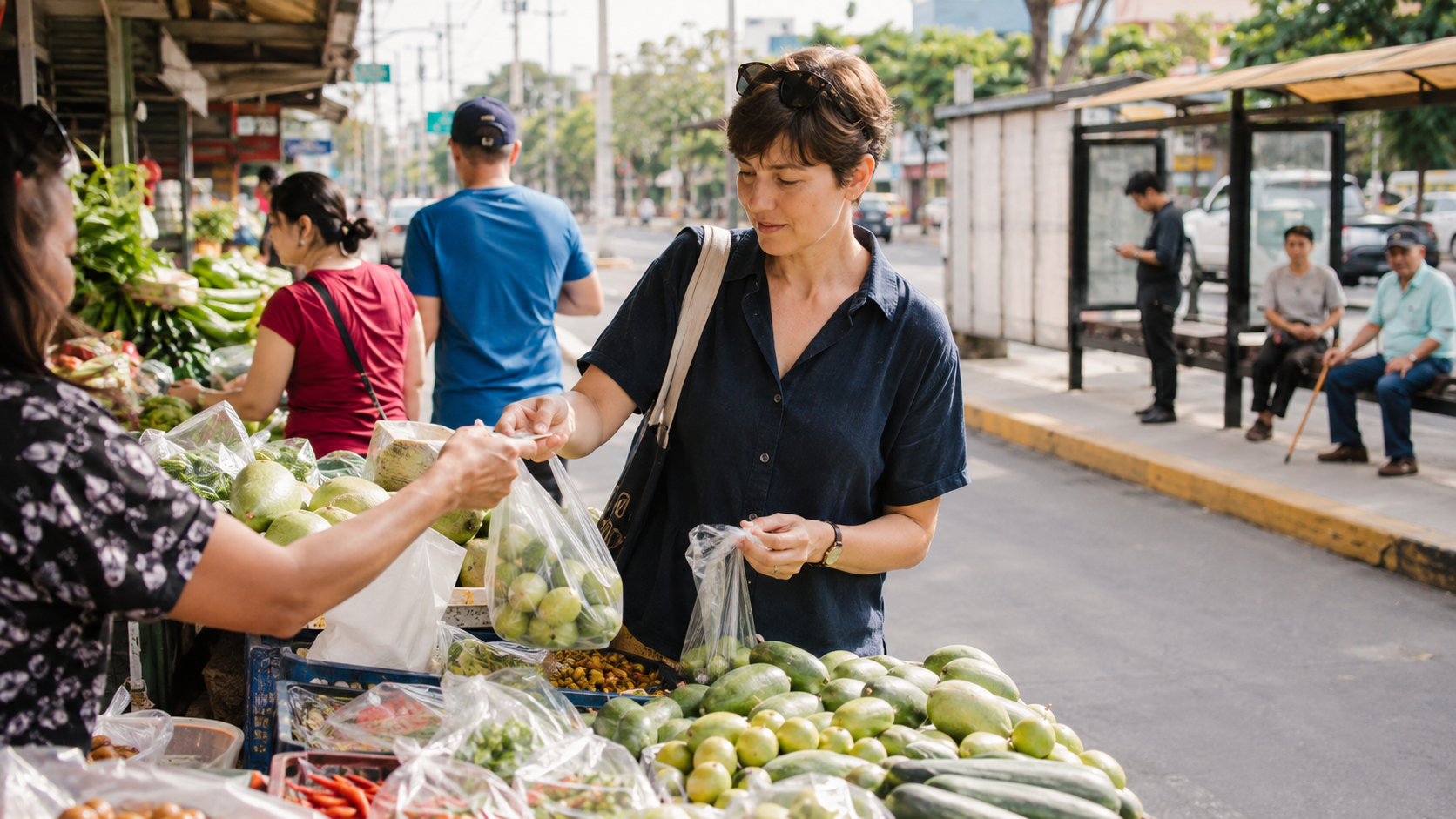
When a route looks good on a map, test it under the conditions that usually expose its weak spots. Carry a grocery bag. Use the bus or metro with a transfer. Walk after a heavy shower. Check the price of a meal in the neighborhood you could actually afford, not only in the visitor district. Look at the same street during a rush period and again after dark, using normal personal-safety judgment.
Also test the services you hope not to need. You do not need to turn the first week into an emergency drill. But it is sensible to identify a pharmacy, a clinic or hospital area, an ATM/bank option, a mobile-service shop, and a place to handle printing or package needs. Health, entry, and safety guidance changes; verify destination-specific information through official sources such as CDC Travelers’ Health and the U.S. Department of State’s international-travel resources before relying on any plan.
Put a ceiling on “fun” before the city puts one on you
Cost creep usually arrives through small decisions: rides instead of a walk, a tourist-zone lunch because you are tired, a class booked on impulse, delivery because the market feels inconvenient. Pick a weekly amount for enjoyable extras after housing and essentials, then track it for two weeks.
If your favorite routine depends on high daily spending, that does not automatically disqualify the city. It does tell you what your actual budget needs to be. The same is true of transport. A neighborhood may be pleasant but become expensive or isolating if every useful trip needs a ride. Compare those observations with the City Fit Dashboard instead of trusting the mood of a first weekend.
What changes after the first week

The second and third weeks reveal conditions the arrival glow can hide:
- Weather and seasonality: rain, heat, air quality, wind, or flooding can change a walkable map into a much smaller daily radius.
- Crowds and noise: a lively street may be enjoyable once but tiring when it affects sleep or every grocery trip.
- Transport reality: frequency, transfers, sidewalk quality, and the cost of getting home after an event matter more than a network diagram.
- Administrative and language load: bills, repairs, deliveries, appointments, and routine questions take more energy than ordering a meal.
- Service access: the right neighborhood is often less about views than how easily you can reach groceries, care, cash, a workspace, and transport when you are not at your best.
Give yourself permission to revise the plan. Move a café from “daily” to “treat.” Switch from a scenic neighborhood to one that makes errands easier. Choose a class closer to home. A successful long stay is not a perfect routine on day three. It is a routine you can adjust without losing the parts that made you want to be there.
Turn observations into a decision
At the end of two to four weeks, write down four answers: What do I return to without effort? What costs more time or money than expected? Which inconvenience is acceptable because the city gives you something valuable in return? And what would become a real problem over three more months?
That record is more useful than a generic ranking. If you are comparing several possible bases, put the answers into the Destination Shortlist Kit. It will help separate a city that is exciting for a week from one that gives you a workable, enjoyable Tuesday.
References
- CDC Travelers’ Health. https://wwwnc.cdc.gov/travel
- U.S. Department of State, International Travel. https://travel.state.gov/content/travel/en/international-travel.html