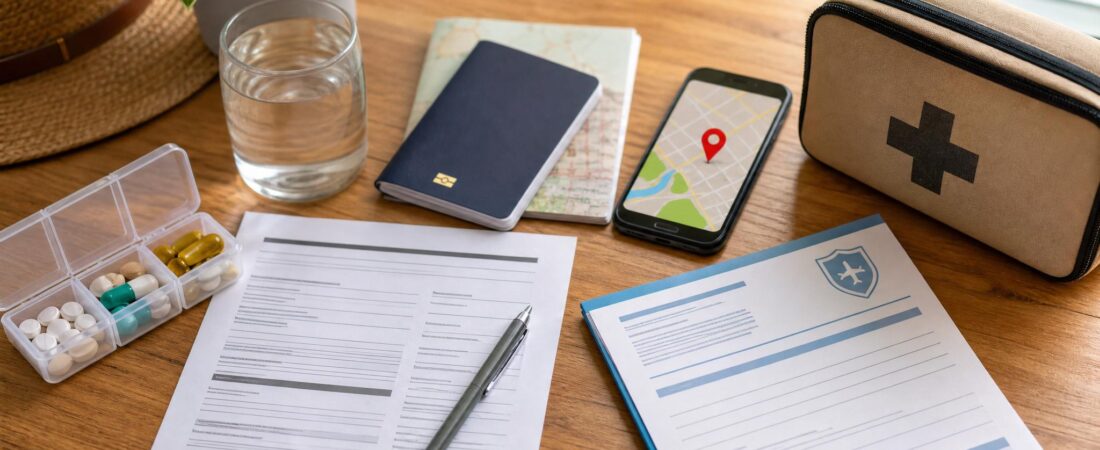
Quick answer: Before you spend months abroad, make a simple healthcare backup plan that answers seven practical questions: what care you already need, which medicines and records you must bring, what your insurance does and does not cover, where you would go locally for care, how you would pay up front, who should be contacted in an emergency, and what would make you move to a bigger city or return to the United States.
This is not a medical treatment plan, not medical advice, and not a recommendation to buy a particular insurance policy or use a particular clinic. Think of it as travel infrastructure. You are trying to avoid the miserable version of an ordinary problem: feeling sick, running low on medication, or needing urgent help while searching your email for an insurance number you never saved offline.
Why a months-long stay needs more planning than a vacation
A one-week vacation can get by with a small travel health kit, your usual prescriptions, and a card in your wallet. A one-to-six-month stay is different. Normal life has more time to happen: blood pressure checks, dental trouble, stomach bugs, injuries, allergies, lab work, medication refills, follow-up appointments, lost bags, travel delays, local holidays, language barriers, and surprise payment rules.
The point is not to expect disaster. Treat healthcare the same way you treat money access, phone service, and apartment Wi-Fi. You do not need every detail solved before you leave, but you do need a fallback path you can use on a bad day.
If you are still comparing countries, pair this with the country research framework in how to compare countries for cost, healthcare, safety, and internet. Healthcare has to be judged at the city and neighborhood level, not just by a country’s general reputation.
1. Start with your real health needs
Before you search for hospitals or compare insurance language, write down what you actually need:
- daily medications, including generic names and dosages
- allergies and serious past reactions
- chronic conditions that could need attention while abroad
- recent surgeries, implants, devices, or mobility limitations
- routine monitoring, such as labs, blood pressure checks, INR checks, diabetes supplies, or specialist follow-up
- dental, vision, hearing, or physical therapy needs that could come up during the stay
- what would count as urgent for you personally
This list keeps you from asking vague questions like “Is healthcare good in Portugal?” or “Are doctors cheap in Mexico?” The better question is: “If my most likely health problem happened while I was staying in this specific neighborhood, where would I go, how would I communicate, and how would I pay?”
For a first long stay, it is usually wiser to choose a base with practical access to clinics, pharmacies, hospitals, transportation, and a larger medical center if you need one. The same grounded logic applies when choosing your first base abroad.
2. Talk to your doctor or a travel clinic before leaving
The CDC recommends making an appointment with a healthcare provider or travel health specialist at least four to six weeks before departure. That window matters because some vaccines, medication adjustments, destination-specific medicines, and documentation questions take time.
Bring the details that affect real planning: your itinerary, length of stay, accommodation type, planned activities, medical conditions, allergies, medications, and supplies you rely on. Someone spending three months in a major city may need a different backup plan than someone staying outside town without a car.
Ask practical questions, not just clinical ones:
- Can I safely carry enough medication for the full stay plus delays?
- Do any of my medications need special documentation?
- Do any supplies require refrigeration or temperature control?
- Should I carry a short medical summary?
- Are any routine vaccines or destination-specific vaccines recommended?
- What symptoms should make me seek care quickly?
This article cannot tell you what is medically right for you. It can tell you that “I’ll figure it out there” is fragile if you depend on prescriptions, monitoring, mobility support, or specialist care.
3. Build your medication and records backup
Medication planning is where longer stays often get messy. A medicine that is routine in the United States may be restricted, unavailable, sold under a different name, or require a local prescription abroad. Some countries have strict rules for controlled substances, ADHD medications, sleeping pills, injectables, and medical marijuana. Transit countries can matter too.
Before departure, check the rules for every country you will enter or pass through, using official embassy or government sources where possible. If you rely on medication, also read the related guides on prescriptions and routine care while living abroad part-time and how Americans can refill prescriptions overseas without turning it into a crisis.
Your medication backup should include:
- medicine in original labeled containers
- enough supply for the whole trip, plus extra for delays if permitted and available
- copies of prescriptions with generic names
- a clinician letter explaining your condition and treatment plan when appropriate
- documentation for controlled substances, injectables, or temperature-sensitive medicines
- a plan for what you would do if a bag is lost, a flight is delayed, or a medication is damaged
- a local-clinic fallback if you need a prescription reviewed abroad
Keep key records both printed and offline on your phone. Do not rely only on a cloud account that requires a U.S. phone number, a working SIM, or two-factor authentication you may not be able to receive. This overlaps with your phone and money setup, so it is worth reviewing phone service for a one-to-three-month stay abroad and your money access backup plan.
4. Understand insurance before you need care
Insurance is not one question. It is a stack of questions that are easy to blur together when a sales page says “travel protection” or “international coverage.” Separate them:
- Does your U.S. health insurance cover emergency care abroad?
- Does it cover routine care abroad?
- Does it cover preexisting conditions during travel?
- Does it require you to pay first and file a claim later?
- Will it pay a hospital directly, or only reimburse you?
- Does it cover your full length of stay?
- Does it exclude certain countries, activities, or conditions?
- Does it include medical evacuation, or is that separate?
The State Department is blunt about the biggest point: the U.S. government does not pay medical costs for U.S. citizens traveling abroad. Travelers are responsible for hospital and medical costs, and in some places payment or a deposit may be required before services are provided.
Medicare deserves special attention. Medicare.gov says Medicare usually does not cover healthcare while you are traveling outside the United States, with limited exceptions. Medicare drug plans also do not cover prescription drugs bought outside the United States. Some Medigap policies may cover emergency care abroad, depending on the policy, but you need to verify your own coverage directly.
Travel health insurance, trip cancellation insurance, and medical evacuation insurance are different products. Trip cancellation coverage may protect prepaid travel costs but not medical bills. Medical evacuation coverage may be separate or an add-on. The State Department notes that medical evacuation by air ambulance back to the United States can cost from $20,000 to $200,000 depending on location and health condition; CDC also warns that evacuation can otherwise cost more than $100,000. For a deeper comparison, read travel insurance vs. paying cash abroad for routine care, urgent care, and emergencies.
Do not buy based on a headline. Read the policy. Ask about preexisting conditions, age limits, length-of-trip limits, direct hospital payment, evacuation rules, 24-hour assistance, planned activities, destination exclusions, and claim documentation. Coverage details are plan-specific, so verify before you rely on anything.
Photo: Harrison Keely, Wikimedia Commons, CC BY 4.0.
5. Map local care near where you will actually live
Do not stop at “the country has good hospitals.” You need to know what is near your apartment and what is reachable without heroic effort. A great hospital two hours away may not help much if you need care at night and do not know how to get there.
Before booking a longer stay, save:
- nearest reputable clinic or urgent-care-style option
- nearest hospital with emergency services
- nearest pharmacy you would feel comfortable using
- local emergency number
- U.S. embassy or consulate page for the country
- your insurer’s international assistance number, if any
- transport options to the clinic or hospital during daytime and at night
Check whether the clinic or hospital has English-speaking staff, international patient services, or appointment booking in a language you can manage. This is not a promise of quality; it is an access check. If you do not speak the local language, prepare a short translated health card with allergies, medications, major conditions, blood type if known, emergency contacts, and insurance information. The CDC suggests having chronic illnesses, medicines, and allergies available in the local language if possible.
This should influence apartment choice. A beautiful rental can be a poor practical fit if it is up a steep hill, far from taxis, difficult for deliveries, or inconvenient to clinics and pharmacies. Use the same grounded approach you would use when evaluating an apartment for a one-to-three-month stay abroad.
6. Prepare for payment, documents, and emergency contacts
In many places, the first healthcare problem is not the doctor. It is access: payment, paperwork, transportation, language, and who can help if you are not thinking clearly.
Your healthcare backup folder should include printed and offline copies of:
- passport photo page
- travel insurance or health insurance card
- policy number and 24-hour assistance number
- medication list with generic names and dosages
- allergy list
- short medical summary if you have ongoing conditions
- emergency contact list
- U.S. embassy/consulate contact information
- local emergency numbers
- payment cards and backup payment method details kept securely
Leave copies of essential trip details with someone you trust at home. Consider enrolling in the State Department’s Smart Traveler Enrollment Program if it fits your trip, so you can receive destination updates and the embassy or consulate can reach you or your emergency contact in a crisis.
Also be realistic about cash flow. Even if care is affordable compared with U.S. prices, some clinics or hospitals may require payment or a deposit before treatment. Your backup plan should include more than one card, a secure way to access emergency funds, and the information you would need if an insurer tells you to pay first and file a claim later.
7. Decide when local care is not enough
A healthcare backup plan should include exit rules. These are not dramatic. They are calm decisions you make before you are tired, scared, or trying to negotiate logistics in another language.
- If I need a specialist, which larger city would I go to?
- If I need imaging, surgery, or hospitalization, where is the better-equipped facility?
- If a medication becomes unavailable, how long before I leave or seek a different city?
- If air quality, heat, altitude, or mobility issues worsen my condition, what is my plan B destination?
- If my insurer or doctor says I should return to the U.S., how would I do that?
Medical evacuation is the extreme version of this question, but not the only version. Sometimes the smarter move is choosing a better base before you go, or moving from a small town to a larger city if your health needs change. A backup plan gives you permission to adjust without treating the adjustment like failure.

Photo: Wellcome Collection, Wikimedia Commons, CC BY 4.0.
A simple one-page healthcare backup plan
Before departure, create a one-page note that answers these prompts:
- My destination: city, neighborhood, address, dates.
- My health basics: conditions, allergies, medications, key restrictions.
- My medication plan: supply carried, documents, refill fallback, storage needs.
- My insurance plan: policy numbers, what to call first, emergency number, claim process.
- My local care map: clinic, hospital, pharmacy, transport route.
- My emergency contacts: local contact if any, trusted person at home, embassy/consulate, insurer.
- My payment backup: primary card, backup card, cash buffer, emergency transfer plan.
- My exit rule: what would make me move cities, end the trip, or seek higher-level care.
Save it offline. Print it. Give a copy or summary to someone you trust. If you change apartments or cities, update it the same day. When you arrive, include this in your first-day practical check, along with locks, Wi-Fi, water, and nearby essentials from the apartment first-24-hours checklist.
Common mistakes to avoid
- Assuming Medicare works abroad the way it works at home. It usually does not, and exceptions are limited.
- Assuming travel insurance covers everything. Policies vary sharply, especially for preexisting conditions, routine care, evacuation, direct hospital payment, planned activities, and longer stays.
- Choosing a destination based on national healthcare reputation. Your real question is local access near your apartment.
- Waiting until medication is almost gone. Refill problems are easier two weeks early than two days late.
- Keeping records only online. Offline and printed copies matter when your phone, SIM, or account access fails.
- Not planning payment. Some clinics or hospitals may require payment or a deposit before care.
- Over-romanticizing remote places. A peaceful town may be lovely and still wrong for your health needs.
Final takeaway
You do not need to turn a months-long stay abroad into a medical project. But you should know what you would do if normal life interrupts the trip. For most Americans, the useful healthcare backup plan is simple: prepare with your doctor, carry the right documents, understand insurance limits, map local care, keep payment and emergency contacts ready, and decide in advance when a place is no longer the right base.
That kind of planning does not make the trip less adventurous. It makes it more livable. The goal is not to expect trouble. The goal is to avoid being surprised by problems you could have planned for calmly at home.
If you are still choosing the country itself, compare this backup-plan work with countries where Americans can look for good healthcare without top-tier Western Europe prices.
For a destination-specific example of why healthcare access and backup planning belong in the same spreadsheet, see how healthcare and city choice affect a moderate Panama budget.
Healthcare access also belongs in the budget comparison. The broader framework in how to choose between a cheap place and a livable place abroad helps weigh clinic access, errands, transport, and exit options together.
Healthcare backup planning gets more useful when tested on the ground. A 30-day city test gives you time to locate clinics, pharmacies, transport routes, and payment options before committing longer.
Healthcare depth is one reason to pressure-test second-tier cities abroad before committing. A cheaper city still needs a realistic clinic, pharmacy, specialist, and larger-hub backup path.
If you are still deciding which base is realistic for a longer stay, use the healthcare-access comparison guide before turning this backup plan into local names, numbers, routes, and documents.
Planning tool
Want the medical prep worksheets?
The Medical Prep Abroad Kit gives you printable templates for medication lists, medical summaries, clinic research, insurance comparison, and emergency contacts.
References
- U.S. Department of State — Medicine and Health: https://travel.state.gov/en/international-travel/planning/guidance/medicine-health.html
- U.S. Department of State — Travel Insurance: https://travel.state.gov/en/international-travel/planning/guidance/insurance.html
- U.S. Department of State — Help Abroad: https://travel.state.gov/en/international-travel/help-abroad.html
- U.S. Department of State — Travel Advisories: https://travel.state.gov/en/international-travel/travel-advisories.html
- CDC Travelers’ Health — Before You Travel: https://wwwnc.cdc.gov/travel/page/before-travel
- CDC Travelers’ Health — Getting Health Care During Travel: https://wwwnc.cdc.gov/travel/page/health-care-during-travel
- CDC Travelers’ Health — Travel Insurance: https://wwwnc.cdc.gov/travel/page/insurance
- CDC Travelers’ Health — Traveling Abroad with Medicine: https://wwwnc.cdc.gov/travel/page/travel-abroad-with-medicine
- Medicare.gov — Travel outside the U.S.: https://www.medicare.gov/coverage/travel-outside-the-u.s.