Quick answer
Quick answer: Choose a Philippines neighborhood by testing the life you will actually live on an ordinary Tuesday: the walk to food and a pharmacy, the realistic route to care, the building’s water/power/internet answers, the time and cost of a ride in poor weather, and whether you can leave or change plans without a financial mess. A beautiful unit or a low nightly rate is not enough. For a first one- to six-month stay, book a short, workable landing period and make the longer decision after you have walked the routes yourself.
Start with a neighborhood, not a city label
“Cebu,” “Manila,” or “an island” is too broad to answer the question that matters: can you do your normal life from this exact building? A listing can be technically close to a hospital, grocery, or airport and still be inconvenient because of traffic patterns, a steep side street, poor sidewalks, a long transfer, or the fact that the useful entrance is not where the map pin lands.
Write down your non-negotiables before browsing. Most readers need a reliable food shop, a pharmacy, cash access, a place to get a SIM or eSIM problem solved, transport that works after dark, and a care option they could reach without improvising. Add your own needs: stairs, mobility, a quiet workspace, a refrigerator for medication, or a building that permits a short initial stay. The point is not to find a perfect district. It is to avoid paying for a view while repeatedly paying for friction.
The Philippines country guide, Philippines for English-Friendly Long-Stay Living in Southeast Asia, is useful for the wider fit question. This guide is deliberately narrower: how to choose the few blocks around your first base.
Do the 20-minute errand map
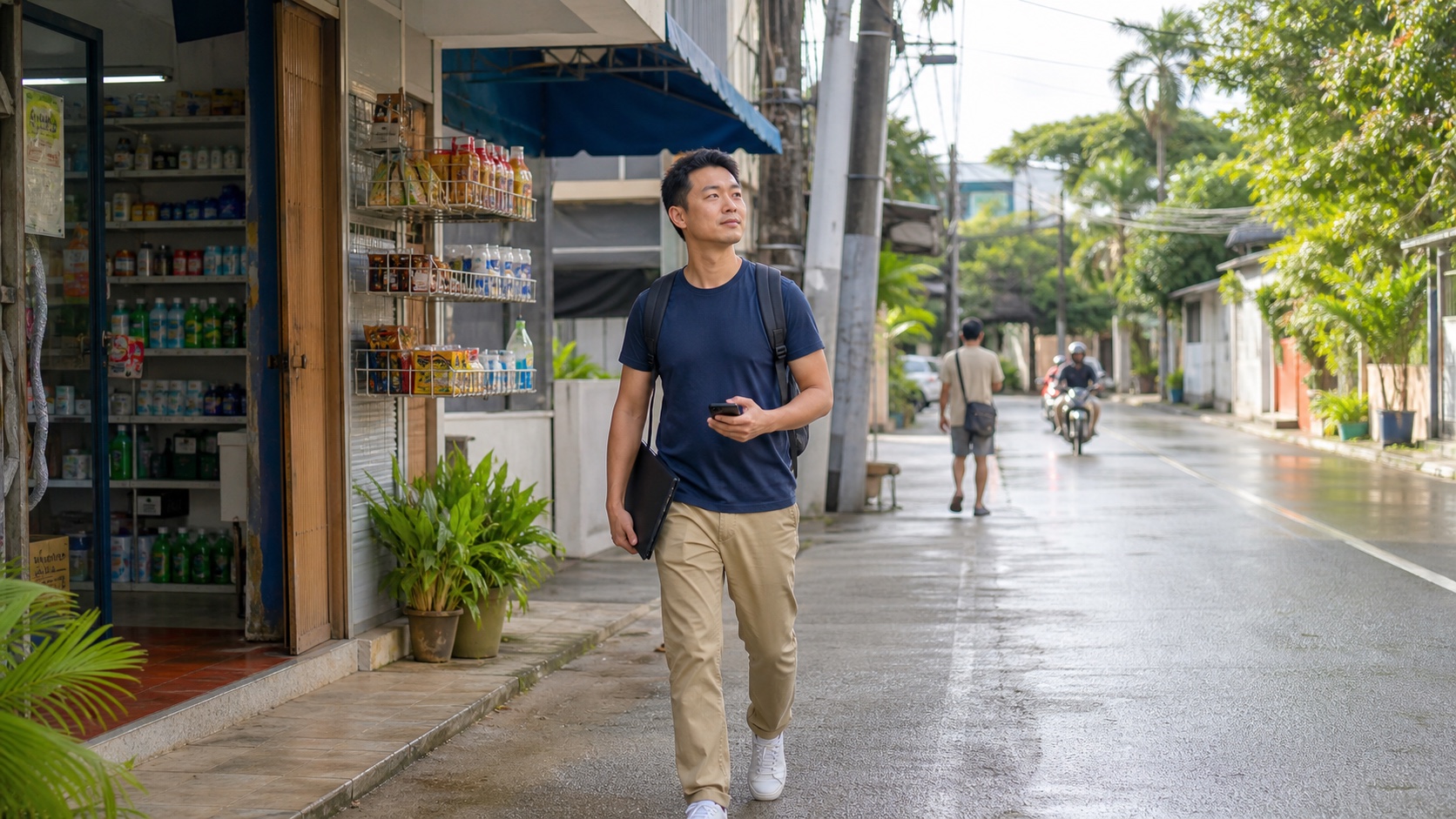
Open a map, then stop using it as the final answer. Make a short list of five places: a grocery, pharmacy, ATM or reliable cash-access point, a clinic or hospital you would genuinely use, and a transport pickup point. Ask the host for the entrance they use, not just a landmark. Then estimate the route at the times you would actually travel: morning, evening, and during rain if that is likely during your stay.
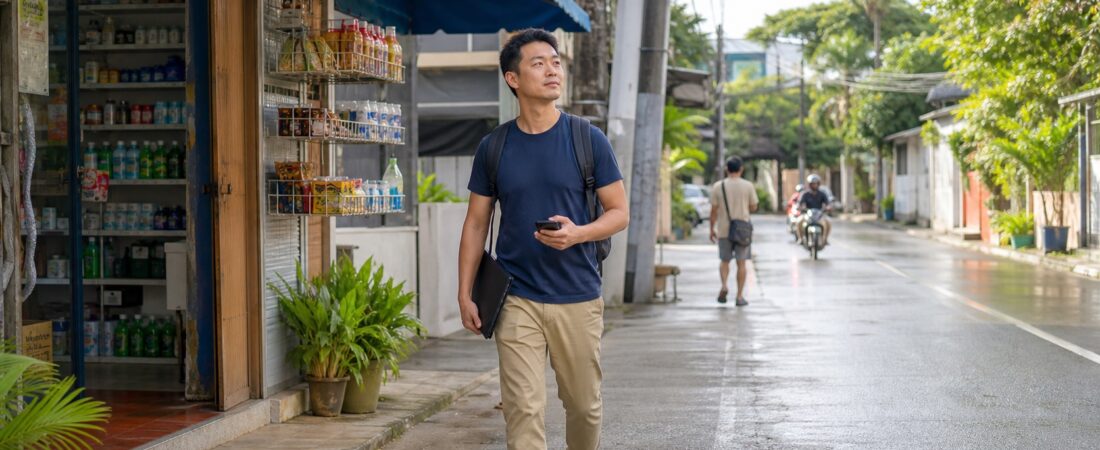
When you arrive, walk it. Notice curb cuts, covered stretches, lighting, traffic crossings, pavement, queues, and whether the store carries the ordinary things you need. A twenty-minute “walk” that requires crossing a hostile arterial road or taking two tricycles is not the same thing as a twenty-minute walk in a compact neighborhood.
Keep a second option for the essentials. One grocery, one payment method, one pharmacy, and one route to care make your plan brittle. You do not need to assume disaster; redundancy is simply cheaper than being forced into a bad choice when you are tired, sick, or caught in a storm.
Ask building questions that a listing cannot answer
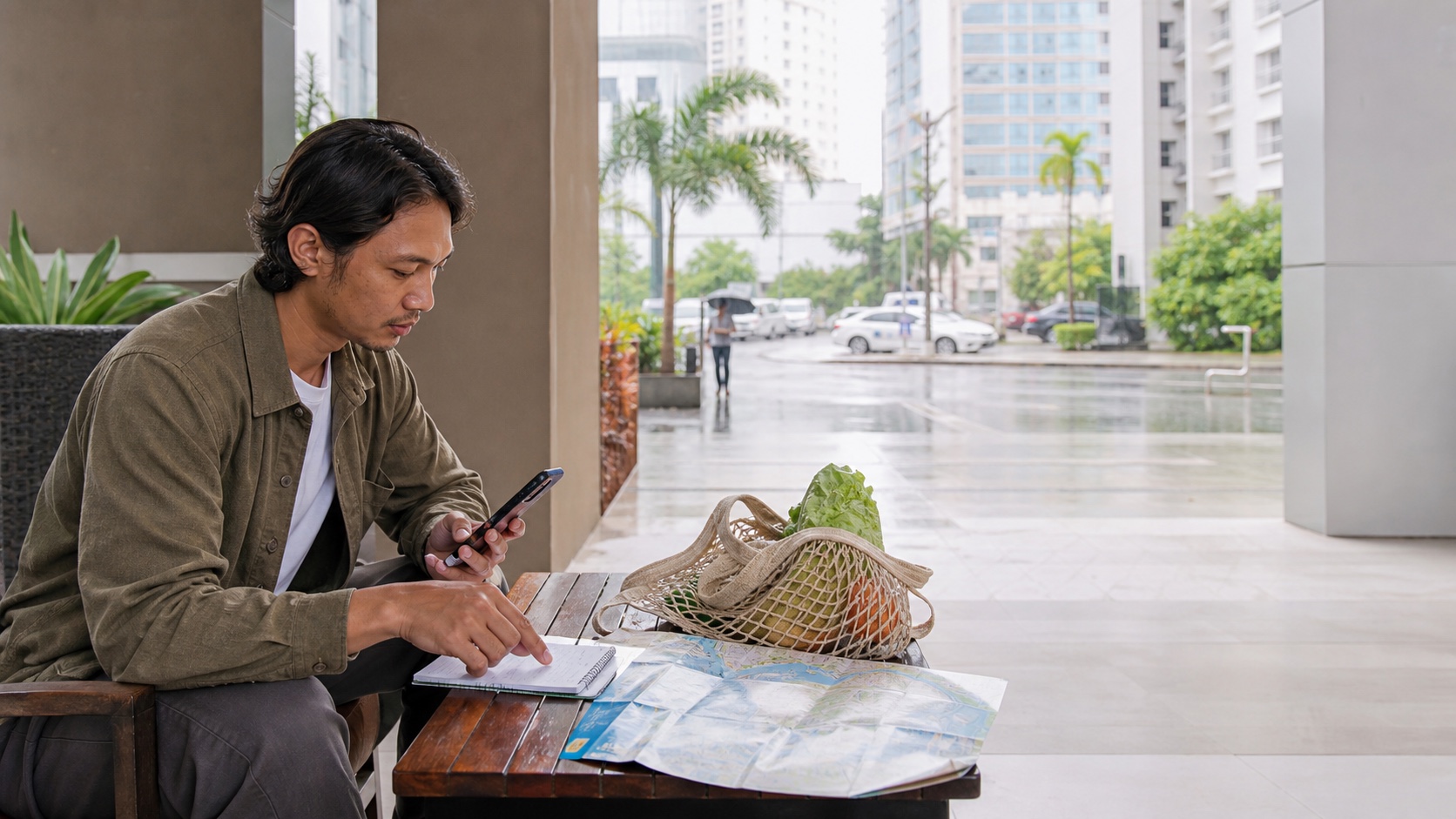
Before paying a long deposit, ask the host or building manager direct questions in writing. Which internet providers serve this unit? Has the service been installed and used recently? What happens during a power interruption? Is there a generator for common areas, a water reserve, elevator operation, or any stated process for residents? Where does water collect during heavy rain? Is the unit exposed to road noise, construction, karaoke, or a late-night delivery route?
Do not interpret a polite “no problem” as documentation. Ask for the provider name, a recent speed-test screenshot if work connectivity matters, and a short video of the entry, hallway, bathroom ventilation, windows, and balcony drainage. The Department of Information and Communications Technology’s national planning material is a reminder that connectivity is an infrastructure question; it does not turn any individual building into a guaranteed remote-work base.
In the first two or three days, test mobile data inside the unit, make one ordinary video call, run the shower, check the refrigerator, and note the route from the lobby to the street. If the arrangement is not workable, it is far better to learn that during a short booking than after signing a long lease.
Put healthcare access ahead of a nicer balcony
Healthcare is not a reason to panic-book beside the largest hospital. It is a reason to make a realistic plan. Identify an appropriate nearby clinic or hospital, save the route, and check the facility directly for current services, hours, payment expectations, and whether it can handle your likely needs. The Department of Health’s regulatory information can be a starting point, but it does not replace confirmation with the provider.
If you take regular medication, choose a first base where you can reach a reputable pharmacy without a complicated transfer. Carry the documentation and lawful supply you need, know the generic names, and keep a backup route and payment method. The more detailed Philippines healthcare and prescriptions guide walks through those preparations.
For many readers, city choice changes the margin for error. Cebu City and Metro Manila can offer deeper service choices but demand closer attention to commute and neighborhood. Dumaguete and Iloilo can offer a different pace, but a smaller-city choice should make you more—not less—specific about the care route. The right decision depends on your medical needs, tolerance for traffic, budget, and mobility, not on an online ranking.
Match the district to the city’s real transport pattern
In Cebu City, a short map distance can be a long trip at the wrong time. Prioritize the exact cluster of errands you will use, then test it against traffic and rain. The Cebu City guide explains the broader services-versus-traffic tradeoff.
In Manila, Makati, and BGC, the neighborhood can determine whether the city feels efficient or exhausting. Higher rent may buy proximity to services, but it does not automatically buy a calm daily routine. Check the building’s drop-off, the walk to groceries, and the actual time to your preferred hospital rather than relying on a district name. Use the Manila, Makati, and BGC guide to compare the wider urban choices.
Iloilo and Dumaguete reward a slower plan: visit a few different areas, walk them at more than one time of day, and see what happens when you need an ordinary errand rather than a café. If an island or beach base depends on one ferry, a small airport, or a narrow road, add arrival slack and keep the first booking short. City or Island? is a useful companion for that choice.
Make wet-weather usability part of the price comparison
The Philippines does not have one identical wet-season pattern across every city and island. PAGASA’s climate information and current forecasts or warnings are the right starting point close to travel. They are not a guarantee for a specific street. Treat rainy-day usability as a property and route check: covered access, drainage, a safe pickup point, nearby food and medicine, and a way home that does not depend on one exposed connection.
A lower rent can lose its value quickly if every grocery trip becomes a paid ride or if a building feels cut off after rain. Conversely, a plain unit near errands can be a very good first base. Planning a Philippines Base During Rainy Season has a fuller checklist for weather-sensitive bookings.
Use a two-stage booking instead of forcing certainty
For a first stay, reserve a hotel, serviced apartment, or flexible short rental in a central, easy-to-leave area. Use that period to test local payment, a SIM, grocery delivery if you expect to use it, the walk home at night, and the route to care. Only then decide whether to extend, move, or sign a longer agreement.
Read the cancellation, deposit, utility, cleaning, visitor, and early-exit terms before sending money. Keep screenshots of the agreed terms and use a payment method with records. For immigration timing, entry conditions, and extensions, use the Bureau of Immigration directly and re-check close to your travel date; the 1- to 6-month stay rules and logistics guide explains why a well-chosen apartment cannot substitute for current official rules.
If you are comparing several city and neighborhood combinations, the Destination Shortlist Kit can help turn this into a repeatable worksheet: rank each option by errand access, healthcare route, housing terms, transport, and the downside you are most willing to accept. It is a planning tool, not a promise that any location will fit every reader.
A simple decision rule
Choose the option that leaves you with the fewest fragile assumptions. A sensible first neighborhood gives you a short and safe-feeling way to get essentials, more than one way to pay or travel, a care plan you have checked, and enough booking flexibility to change course. That is usually more valuable than a slightly better view, a trendier district name, or a rental that looks cheapest before daily transport and friction are counted.
References
- Philippines Bureau of Immigration, Visa Waiver. Verify current entry and extension conditions directly.
- PAGASA, Climate of the Philippines and current forecasts/warnings.
- U.S. Department of State, Philippines International Travel Information. Check current notices directly before travel.
- Philippine Health Insurance Corporation, PhilHealth.
- Department of Information and Communications Technology, National Broadband Plan.
Backup planning for a longer stay: How to Set Up Power, Internet, and Money Backups for a Long Stay in the Philippines
Apartment setup for a longer stay: How to Rent an Apartment in the Philippines for a 1- to 6-Month Stay